


How AI Saved my Life*
*Or at least extended it baring accidents.
It’s become popular to hate AI—and understandably so. Our social media feeds are filled with “AI slop,” our mailboxes with AI-generated spam. Datacenters are consuming potable water and driving up the cost of computing in a mad capitalist rush toward what may be a looming economic correction—all built on our collective creative works, without permission, remuneration, or ethical standards.
Yep. All valid. But complaining won’t change the world we live in, and in the meantime—at least until the bubble bursts—AI offers an intellectual power tool of historic importance. Refusing to use it won’t stop its rise; it will only widen the gap between those who know how to use it and those who don’t.
I posted previously about how I used AI to finally return my blood serum lipid profile to normal after over 20 years of fruitless trying. Since then, I’ve had several requests for more detail—about the journey itself, and about how, specifically, I used AI to get there.
The Starting Point
In my case, I began by asking the free version of ChatGPT 3 for help understanding the bewildering and often contradictory research around cholesterol and lipid health. Biochemistry is complicated—who’d have thought? The results were interesting, but not especially useful. By that point (early spring of 2025), however, I’d been using AI long enough to recognize its real strength. Yes, it can be wrong. Yes, it can be overly eager to please. But it can also synthesize vast bodies of complex information and produce reasonable—if not always correct—conclusions. I’d seen that in editorial research. I’d seen it in Java programming. AI isn’t a person; it doesn’t understand anything. But it can be one hell of a research assistant—if you’re willing to do your part.
So I changed my approach.
From “Advice” to Negotiation
Instead of asking for general guidance, I gave ChatGPT a detailed summary of my actual diet:
- No breakfast
- A mocha latte for lunch
- A Caesar salad for dinner with sweetened yogurt and sweetened fruit
- A bedtime snack of Cheerios and Dipps bars
I also provided my test results and a clear goal: improve my lipid profile. The response was exactly what you’d expect: “Just eat tasteless health food and everything will be fine.” No thanks. But instead of dismissing it, I negotiated. I asked for suggestions that modified what I was already eating rather than replacing it wholesale. I asked follow-up questions. I pushed back on impractical ideas. I kept refining until I landed on something I could actually live with. That’s the key: AI is not an oracle. It’s a collaborator—one that requires supervision.
What I Learned (and Verified)
Along the way, I learned—and independently verified—a number of things:
- Cheerios are not especially healthy. Oats are beneficial, but once processed into sugary cereal, they’re not much better than dessert.
- Croutons add flavor, but mostly as empty calories and refined carbohydrates.
- Cream-based Caesar dressing is calorically dense and metabolically unhelpful.
- Cheap lettuce mixes are low in soluble fiber, limiting their impact on cholesterol.
- Dipps bars are not just high in calories—they’re high in saturated fat.
- Powdered coffee creamer is essentially empty calories plus unhealthy fats.
- Traditional lattes can contribute significant calories and compounds that raise LDL cholesterol.
- Skipping breakfast can increase later cravings and negatively affect insulin response.
- Relying on a latte as “lunch” is not a nutritionally sound strategy.
None of this is revolutionary. But seeing it all together—and tailored to my actual habits—made it actionable.
The Changes
I ended up with a diet that looked, on the surface, only modestly different:
- A small breakfast of trail mix
- A Misto (coffee with milk rather than espresso-heavy) and a ~200-calorie chicken pocket for lunch
- A dinner salad built on romaine plus kale, spinach, or cabbage, topped with guacamole and pistachios, along with Quorn (mycoprotein) nuggets
- No more coffee creamer
- No more late-night cereal or snack bars—replaced with oatmeal and trail mix
- Oatmeal evolving from sweetened instant to savory Indian-style (Saffola), mixed with steel-cut oats and supplemented with whey protein isolate
This wasn’t a radical overhaul. It was a series of substitutions.
But the effect was exactly that.

Why It Worked
One of the more surprising suggestions was replacing salad dressing with guacamole and croutons with pistachios. At first glance, that seemed counterintuitive—both are calorie-dense. But comparisons are relative, and biology is complex. Yes, guacamole and pistachios are high in calories. But Caesar dressing can be dramatically higher, and these alternatives provide fiber, healthy fats, and phytonutrients that support gut health and metabolic regulation. Similarly, I had previously avoided Saffola oatmeal because of its sodium content. But I wasn’t accounting for the total sodium in everything I ate. When viewed holistically, the new diet actually reduced my overall sodium intake. You don’t think of cereal, salad dressing, or snack bars as major sodium sources—but they add up. The revised diet ended up being lower in sodium, lower in empty calories, and significantly more nutrient-dense.
ChatGPT was also helpful in performing “what-if” analysis. I could propose a change, ask what effect to could be expected to have in one month or six months, and get answers that turned out to be amazingly reliable.
The Results
The biggest change came in the first month: Roughly 11% improvement in lipid markers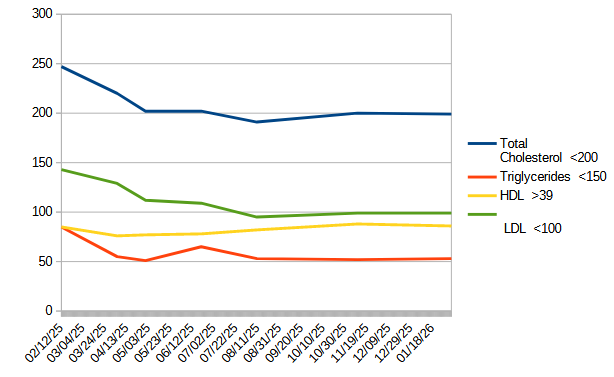
By six months: Nearly 20% improvement, confirmed by blood tests.
After that, changes were incremental:
- Adding inulin fiber to oatmeal
- Switching from oat milk to almond milk
- Experimenting (and abandoning) fiber-based coffee creamer substitutes
Then I stayed the course. By August, my lipid panel was normal. By year’s end, I was seeing signs of improving arterial health. I had already begun splitting my blood pressure medication between morning and evening to stabilize readings. If current trends continue, it’s possible the dosage may eventually be reduced.
Final Thoughts
We each have our own path. I was starting from a relatively strong baseline: generally healthy, already at a reasonable weight, and exercising regularly (about four miles on a bike most days). Your mileage will vary. But this experience demonstrated something important: a handful of small, coordinated lifestyle changes can produce significant health improvements. And like it or loathe it, AI can help. If you treat it like what it is—a powerful, imperfect tool—you can get real value out of it.
If you treat it like an authority…
Well, we’ve all heard about the man who asked an AI how to reduce sodium and ended up poisoning himself with pool chemicals. Whether the story is apocryphal or not, the lesson stands: if you outsource your judgment, you’re going to have a bad time.
So—use some common sense.