


What the Heck is Up With These Guys?
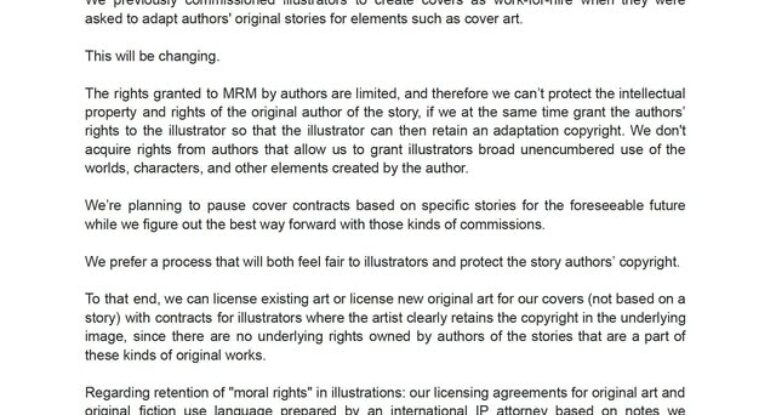
Analog’s official Facebook account has posted the following rather bizarre statement:

This is frankly astonishing. MRM is treating a routine publishing-rights matter as though it has discovered an unprecedented legal obstacle. It hasn’t. Magazine publishers, book publishers, illustrators, and licensing attorneys have been negotiating precisely these distinctions for generations.
The statement also seems to conflate several quite different things. Nevertheless, I’ve sold a lot of stories to Analog and have a deep an abiding love for the magazine and affection for its editorial staff, so I will restrict my remarks to the legal points in this statement as I understand them:
1. Work for hire is not the only way to commission an illustration
A publisher can commission artwork under a conventional contract that specifies which rights are being transferred or licensed, for what purposes, and for how long.
An illustrator might retain copyright while granting the publisher an exclusive license to reproduce the illustration on a particular cover, in advertising, and in subsequent editions.
Alternatively, the publisher might acquire copyright outright through a written assignment, subject to whatever limitations are necessary to protect the author’s underlying work.
None of this requires reinventing publishing contracts.
2. Derivative works have been around a very long time
Their central argument appears to be that an illustrator who retains copyright in an adaptation of a story somehow acquires rights that interfere with the original author’s intellectual property.
But copyright in a derivative work extends only to the original material contributed by its creator. It does not confer ownership of the underlying work.
For example, an illustrator might own copyright in a painting of a spaceship described in a story without acquiring the right to write sequels about that spaceship or authorize unrelated adaptations of the story.
There can certainly be complications involving recognizable characters, settings, and other protected elements. But those are precisely the complications that contracts and derivative-work licenses are intended to resolve.
3. The actual problem may be the limited rights MRM has acquired
This is the one part of their statement that deserves closer attention:
The rights granted to MRM by authors are limited, and therefore we can’t protect the intellectual property and rights of the original author of the story.
That might reveal a genuine contractual problem–one easily solved by clarifying the contract. If MRM has acquired only first-publication rights to a story, without sufficient authorization to commission and exploit derivative illustrations, it simply needs to revise its author agreements or obtain additional permission. But that is a problem of what rights the publisher has negotiated, not an inherent incompatibility between author copyright and illustrator copyright and the obvious remedy would seem to be negotiating appropriate rights, not suspending story-specific cover commissions indefinitely.
4. The moral-rights discussion is particularly peculiar
In American copyright law, moral rights are relatively narrow, particularly for commercial illustrations. The Visual Artists Rights Act protects certain works of visual art, but its application to illustrations created for magazines is limited by statutory exclusions. Moreover, moral rights and economic copyright are different legal concepts. Eliminating a waiver of moral rights does not, by itself, determine who owns copyright or whether an illustration can be licensed.
The statement presents this as another major contractual innovation, although moral-rights provisions have long been familiar territory in international publishing.
5. There is one legitimate distinction worth preserving
A commissioned cover based on an author’s story is legally more complicated than a generic painting of a spaceship that happens to be used on a science-fiction magazine. The former may constitute a derivative work; the latter generally doesn’t.
MRM is right to recognize that distinction, and protecting illustrators from unnecessarily broad work-for-hire arrangements is a reasonable objective, but the existence of a legal distinction does not make it an unsolved legal problem.
Analog and every other science fiction magazine, has been using illustrations reflecting the fiction inside for as long as there have been science fiction magazines. This is not new.