


How Guacamole Slashed my Heart Attack Risk
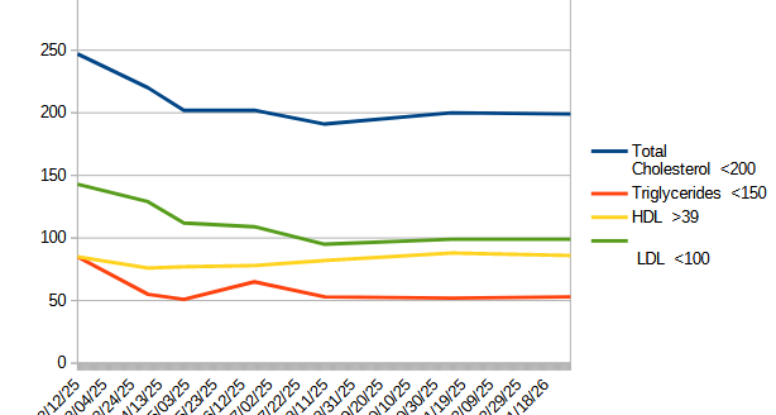
A year ago, after decades of incremental dietary improvements, after loosing a quarter of my body weight bicycling during and after COVID, after returning to the office with a new commitment to healthy living — my cholesterol was worse than ever, with a total cholesterol of 247 and LDL at 143, I was at high risk for atherosclerosis, heart attack, dementia, and early death–even if my doctor put me on statins. And as I’ve blogged after this before, I was pissed.
I had never exactly been a health nut, but as the years and the pounds piled on, I’d incrementally made dietary changes in the direction I thought was healthy–only to see the reverse. Now, with the advent of AI, with essentially the sum total of human knowledge at my fingertips, with access to cheap blood testing to prove the point, I decided to see what lifestyle changes could accomplish when done right according not to some guru or influencer, but the sum total of the evidence.
I’ve blogged before about how I asked ChatGpt to review my diet and make recommendations, how I steered it to practical solutions, how I asked it for “what if projections” that helped me redesign my diet.
It didn’t take anything exotic. I didn’t go keto. I didn’t move into the gym. I didn’t swear eternal vengeance against carbohydrates. I simply started making a series of practical, sustainable substitutions and paying attention to patterns.
The details are in my previous blogs, but the TLDR is, I continued riding a few miles a day on my bicycle and:
- cut back heavily on processed snack carbs,
- increased souble-fiber,
- increased phytonutients,
- reduced saturated fat,
- shifted overall to lower glycemic index alternatives.
That’s it. I still eat the same things as before, just totally different. Actual oats instead of Cheerios. Trial mix instead of Dipps bars. Romain & kale instead of iceberg. Pistachios instead of croutons. Guacamole instead of Ceasar dressing. Cafe O’lait with stevia instead of Mocha Latte.
Folks, I’m not giving anything up. I’m eating and enjoying better food across the board.
I lost more weight without even trying. In six months, my total cholesterol dropped 23%, my (harmful) LDL cholesterol 34%. But that’s only part of the story. My doctor ordered a CAC scan, a special x-ray that looks for calcified plaque in the heart. It found none–great–but it the soft plaques that kill you. So I paid for am advanced lipid profile, a test that tells you how much of your LDL lipids fall into different particle sizes. This gives clues as to whether those dangerous, soft arterial plaques are likely growing or regressing, and gives insight into what’s going on with lipid metabolism.
I had the test, got ChatGPT to interpret the rather alarming numbers, and waited. Blood lipids are slow to respond to lifestyle changes, particle sizes even more so. It would take 6 months to a year to really see the results. This week, I got them:
Overall, my LDL particle count has dropped by 22%. Small LDL particles–the most dangerous kind that can easily infiltrate arterial walls and start plaque formation–have dropped by 28%. Medium LDL particles also improved significantly. My inflammatory marker hs-CRP came back at an almost comically low 0.03.
My numbers aren’t perfect. My fasting glucose still runs a little higher than I’d like, and my LDL particle count is still high. But the pattern has changed dramatically. A year ago, my results looked like someone steadily heading for a coronary. Now they look much more like someone with generally healthy metabolic markers, some age- and genetics-related risk, but trending in the right direction.
One of the most important lessons I’ve learned is that improvement doesn’t always look dramatic from month to month. Some of my numbers even bounced slightly the wrong direction after their initial big improvements. But over the longer trendline, the change is unmistakable.
I also learned that advanced lipid testing tells a more nuanced story than total cholesterol alone. Two people can have similar LDL cholesterol numbers while having very different particle counts and cardiovascular risk profiles.
At this point, I still haven’t decided whether I’ll eventually take a low-dose statin. I may. But if I do, it will not be because lifestyle changes “failed.” It will be because lifestyle changes succeeded enough to leave me debating whether additional optimization is worth pursuing. And it won’t be becaue my GP sees illness and wants to treat it–but because we are working together to keep me healthy.
That’s a much better place to be than where I started.
For now, the plan is straightforward: keep doing what I’m doing, make a few small dietary tweaks, and have my lipid checked again in 6 months to monitor trends.
I’ll need t have my blood pressure medicine adjusted anyway. My blood pressure has dropped from an average of 139/85 to now around 119/75.
No miracle diets. No magical supplements. Just sustained, practical changes that gradually shift trajectory.
And honestly, that may be the most encouraging part of all.